


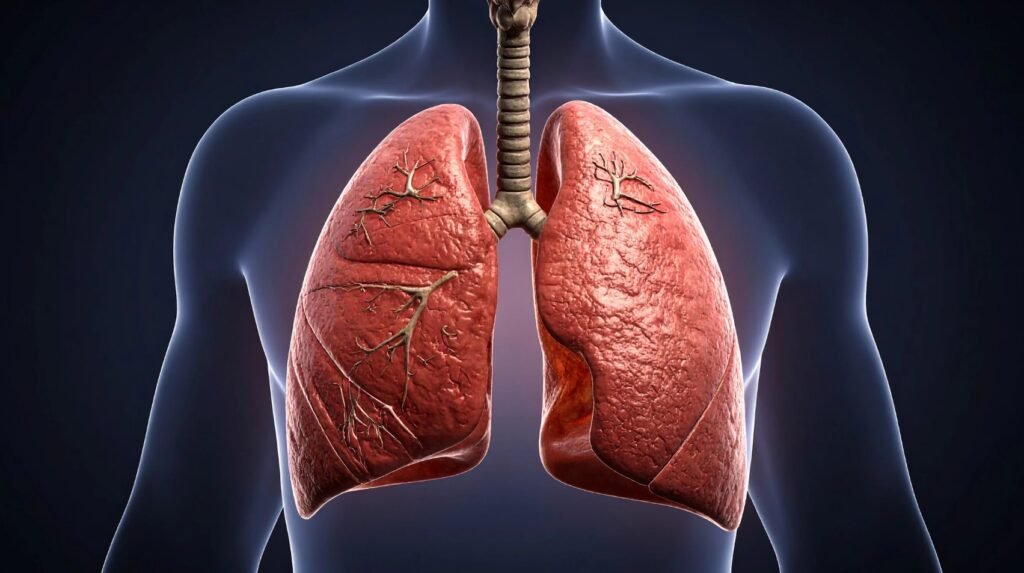
For the more than three million Americans living with emphysema, a severe form of Chronic Obstructive Pulmonary Disease (COPD), each breath can feel like a battle. For those in the advanced stages, life often shrinks to the length of an oxygen tube, with simple joys like a walk in the park or playing with grandchildren becoming distant memories. But a revolutionary, minimally invasive procedure is turning the tide, offering a new dawn for patients who thought they had run out of options. This is not a story about managing a decline; it’s a story of resurgence, of reclaiming independence, and of breathing freely once again—one step, one climb, and one precious moment at a time.
In Brief: A New Chapter for Emphysema Patients
- 😮💨 Understanding Emphysema: A progressive lung disease where damaged air sacs (alveoli) trap air, causing severe shortness of breath.
- 💡 A Treatment Gap: Patients with severe (Stage 3 or 4) emphysema often find medications are no longer enough, but they aren’t candidates for major lung surgery.
- ✨ A Breakthrough Hope: Minimally invasive endobronchial valves are placed via bronchoscopy to block off the most damaged parts of the lungs, allowing healthier tissue to function more efficiently.
- ✅ Life-Changing Results: Many patients experience significantly improved lung function, less breathlessness, and a dramatic increase in their quality of life, enabling them to return to cherished activities.
From Being Trapped to Taking Charge: The Reality of Severe Emphysema
Emphysema is a relentless disease. It works by destroying the tiny, delicate air sacs in the lungs called alveoli. In healthy lungs, these sacs expand and contract like tiny balloons, facilitating the exchange of oxygen and carbon dioxide. In a person with emphysema, the walls of these sacs weaken and rupture, creating larger, inefficient air spaces that trap stale air. This process, known as hyperinflation, makes it incredibly difficult to breathe and puts immense strain on the diaphragm. “I felt like I was constantly suffocating,” shares Patricia, a fictional patient inspired by real stories. “I needed my portable oxygen 24/7. My world had become the four walls of my home. I desperately wanted some sort of normalcy back.”
Decoding the Stages of Emphysema
Doctors classify the severity of emphysema into four stages based on a key lung function measurement called FEV₁, which is the amount of air you can forcefully exhale in one second. While early stages can be managed with medication and lifestyle changes, the later stages present a significant challenge. This is where many patients feel they hit a wall, no longer responding to inhalers but considered too frail for lung volume reduction surgery.
| Stage 📈 | Severity | FEV₁ (% of predicted value) | Common Symptoms |
|---|---|---|---|
| Stage 1 | Mild | ≥ 80% | Minimal symptoms, often unnoticed. |
| Stage 2 | Moderate | 50-79% | Shortness of breath with exertion. |
| Stage 3 | Severe | 30-49% | worsened breathlessness, reduced activity. |
| Stage 4 | Very Severe | < 30% | Quality of life is severely impaired. 😥 |
A Tiny Valve, A Giant Leap for Lung Health
For patients like Patricia, new hope has arrived in the form of endobronchial valve treatment, such as the Spiration Valve System. This breakthrough procedure offers a minimally invasive solution that is redefining the standard of care. During a simple, one-time procedure that takes less than an hour, a doctor uses a bronchoscope to place several tiny, one-way valves into the airways leading to the most diseased parts of the lung. There are no cuts or incisions involved. These remarkable valves allow trapped air to escape when the patient exhales but prevent new air from entering on the inhale. This helps the damaged lobe shrink, reducing hyperinflation and allowing healthier lung tissue to expand and work more efficiently. The diaphragm can function properly again, making every breath easier and more productive.
Could This Revolutionary Procedure Be for You?
This procedure is a game-changer, but it’s important to note that it is not for everyone. Patient selection is a critical part of its success. Ideal candidates are those who have found their lives severely limited by their condition despite optimal medical therapy. The care team conducts a thorough evaluation, including CT scans and lung function tests, to ensure the patient’s specific lung anatomy is suited for the valves. If you’ve been told you have few options left besides invasive surgical options, this could be the conversation to have with your pulmonologist.
- ✅ You have a confirmed diagnosis of severe emphysema.
- ✅ You experience disabling breathlessness despite using inhalers and oxygen.
- ✅ Pulmonary function tests show significant hyperinflation of the lungs.
- ✅ You are not a suitable candidate for more traditional surgical procedures.
- ✅ A high-resolution CT scan shows your diseased lobes are distinct from healthier tissue.
“For me, it was a miracle,” Patrisa Williams, one of the first patients to receive the procedure in Northern California, told UC Davis Health. “I can breathe so much better. It has given me back the quality of life I was lacking.” While there are some risks, such as a collapsed lung, patients are monitored closely in the hospital for a few nights. For many, the reward is immeasurable: a future where they can hike, play, and live again, far beyond the confines of their disease. It’s crucial to learn the facts and move beyond the common myths about lung surgery to see if this path is right for you.
How long is the recovery after the endobronchial valve procedure?
Patients typically stay in the hospital for 3 to 4 nights for close monitoring. The primary risk immediately following the procedure is a pneumothorax (collapsed lung). Once home, patients are encouraged to restart pulmonary rehabilitation and gradually increase their activity levels. Most begin to notice significant improvement within a few weeks to months.
Is the valve procedure a cure for emphysema?
No, endobronchial valve placement is not a cure for emphysema or COPD. It is a palliative treatment designed to significantly reduce symptoms, improve lung function, and enhance quality of life for patients with a specific type of severe emphysema. It does not reverse the underlying lung damage.
Are the valves permanent?
One of the key advantages of this system is its reversibility. If a patient does not experience the expected benefits or if complications arise, the valves can be removed using another minimally invasive bronchoscopy procedure, leaving other treatment options open.
Please note: The illustration photo accompanying this article was generated by AI. Fictional testimonials may have been included for illustrative purposes to protect patient privacy, though they are based on the outcomes of real patient experiences.